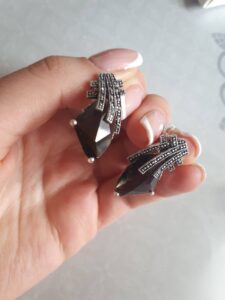
Marcasite jewelry is admired worldwide for its metallic shimmer and vintage charm, yet many people are surprised to discover that true marcasite is rarely used in jewelry. Instead, most pieces marketed as “marcasite jewelry” actually contain pyrite, a more stable mineral that delivers the same beautiful sparkle—but with greater durability.
This chapter explains the real differences between marcasite and pyrite, why the jewelry industry prefers pyrite, how each mineral behaves in jewelry settings, and what buyers should know when evaluating pieces labeled as “marcasite.” By the end, you’ll understand not just the visual distinctions but also the geological, chemical, and craftsmanship factors that define both minerals. marcasite
What Is Marcasite?
Marcasite is a naturally occurring mineral composed of iron sulfide (FeS₂)—the same chemical composition as pyrite but arranged in a different crystal structure.
Characteristics of true marcasite:
- Pale, brassy yellow color
- Brittle and fragile structure
- Tendency to crack or crumble
- Susceptibility to oxidation
- Reacts with moisture and acids over time
Although beautiful in raw form, marcasite is unstable, making it unsuitable for jewelry.
What Is Pyrite?
Pyrite, commonly known as “Fool’s Gold,” is also made of iron sulfide (FeS₂), but with a different atomic arrangement.
Characteristics of pyrite:
- Brighter metallic shine
- Gold to steel-grey color
- Stronger and more durable than marcasite
- Resistant to cracking
- Easy to polish and facet
These qualities make pyrite ideal for marcasite-style jewelry.
Fun Fact:
Nearly 100% of all marcasite jewelry on the market uses pyrite stones—not actual marcasite.
Why the Jewelry Industry Uses Pyrite Instead of True Marcasite
There are several reasons why pyrite became the industry standard.
1. Durability
True marcasite is too fragile for jewelry.
- It can break during cutting
- Crumbles under pressure
- Deteriorates when exposed to moisture
Pyrite, by contrast, withstands cutting, polishing, and daily wear.
2. Oxidation Issues
Marcasite reacts with humidity, producing sulfuric acid.
- This causes discoloration
- Weakens metal settings
- Can damage surrounding stones
Pyrite is far more stable and does not create harmful chemical reactions.
3. Superior Shine
Pyrite has a brilliant metallic sparkle ideal for faceting.
- Reflects light beautifully
- Enhances vintage and Art Deco styles
- Maintains lustre for decades
4. Easier to Cut and Shape
Pyrite can be cut into uniform shapes:
- Rose cut
- Square
- Round
- Step-cut
This allows consistent design patterns in marcasite jewelry.
5. Historical Tradition
Since the Victorian era, jewelers began using pyrite for reliability.
Consumers loved the aesthetic, and the name “marcasite jewelry” simply stayed.
Comparing Marcasite and Pyrite: Key Differences
| Feature | Marcasite | Pyrite |
| Chemical Formula | FeS₂ | FeS₂ |
| Crystal Structure | Orthorhombic | Cubic |
| Durability | Very brittle | Strong and stable |
| Color | Pale yellow | Gold to steel-grey |
| Reaction to Moisture | Oxidizes quickly | Minimal reactivity |
| Suitability for Jewelry | Poor | Excellent |
Despite sharing a formula, their physical properties differ drastically.
How Jewelers Identify Pyrite vs. Marcasite
Professional jewelers can distinguish between the two using:
1. Crystal Shape
- Pyrite forms cubes and octahedrons
- Marcasite forms spear-like or tabular crystals
2. Surface Texture
Pyrite has a shinier metallic finish.
3. Hardness Test
Pyrite: 6–6.5 on Mohs scale
Marcasite: 6–6.5 but more brittle due to structure
4. Color Depth
Pyrite displays richer hues.
Most “marcasite” jewelry stones are visibly pyrite under magnification.
Why the Name “Marcasite Jewelry” Remains Popular
The term has been used for over a century and refers to the style, not the mineral.
Reasons the name persists:
- Historical tradition
- Marketing familiarity
- Consumer expectation
- Cultural association with vintage silver jewelry
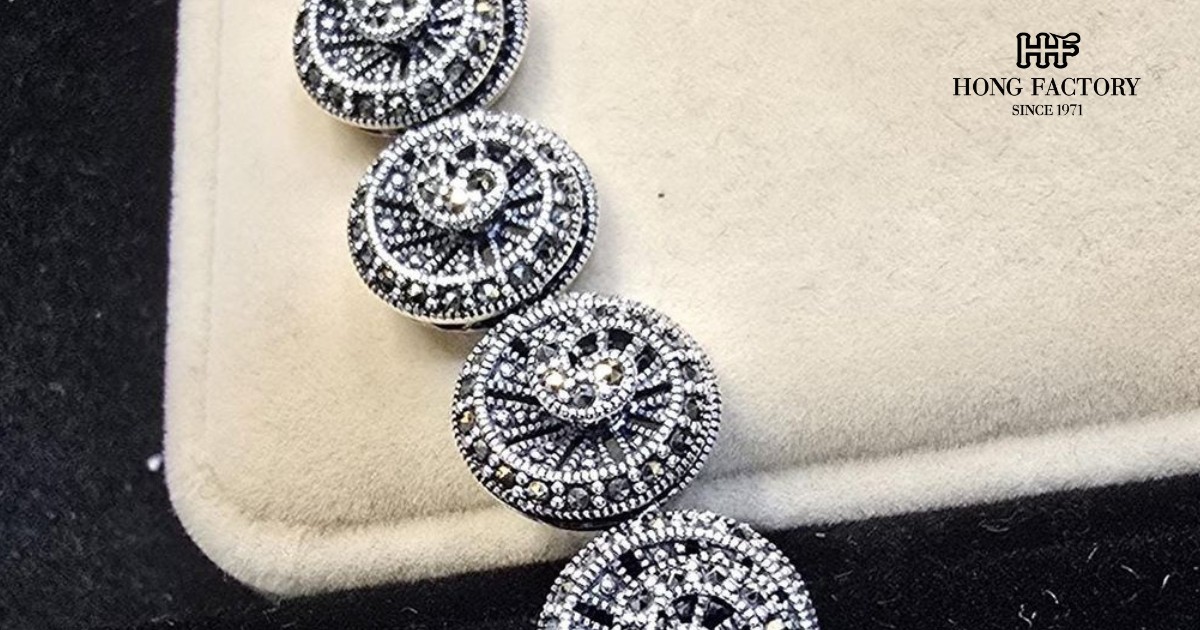
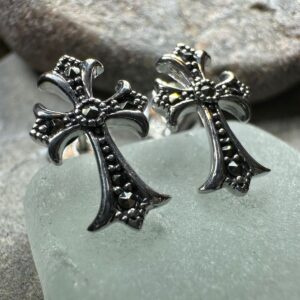
Thus, marcasite jewelry continues to describe silver pieces set with faceted pyrite stones.
How Pyrite Performs in Marcasite Jewelry Settings
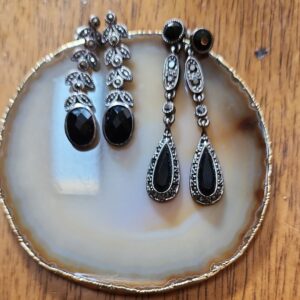
Pyrite’s durability allows jewelers to use intricate setting techniques.
Works perfectly with:
- Bead setting
- Pavé setting
- Prong setting
- Channel setting
Artisans can place dozens—or even hundreds—of tiny pyrite stones in one piece.
Pyrite also withstands polishing and finishing processes without crumbling.
The Aesthetic Appeal of Pyrite in Marcasite Jewelry
Pyrite offers a distinctive sparkle beloved by collectors.
Visual advantages:
- Strong contrast against sterling silver
- Subtle yet glamorous shine
- Vintage-inspired look
- Works beautifully with black onyx, pearls, mother-of-pearl
Its metallic lustre captures the essence of antique elegance.
Misconceptions About Marcasite Jewelry
Many buyers assume:
- Marcasite is a gemstone
- It is a type of silver
- It is related to marcasite minerals used in geology
In reality:
- Marcasite refers to the style
- Pyrite is the actual stone
- The jewelry’s value lies in craftsmanship, not mineral rarity
Understanding this enhances appreciation for artisanal marcasite pieces.
Collectors’ Perspective: Does It Matter?
Most collectors agree:
No—it does not lower the value.
Marcasite jewelry is valued for:
- Intricate designs
- Hand-set craftsmanship
- Historical relevance
- Silverwork quality
The use of pyrite is standard and accepted globally.
How to Spot High-Quality “Marcasite” Jewelry
Look for:
- Consistent faceting
- crisp metallic shine
- Solid 925 sterling silver
- Even stone placement
- No glue in settings
- Clean beadwork
Avoid:
- Dull stones
- Uneven colors
- Loose settings
- Cheap base metals
Quality depends far more on craftsmanship than on the distinction between minerals.
Conclusion
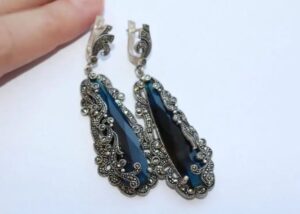
While the term “marcasite jewelry” may imply that it contains true marcasite, the industry standard—and the superior choice—is pyrite. Its durability, shine, and structural stability make it the ideal stone for creating the vintage-inspired brilliance that defines marcasite jewelry.
Understanding the difference between marcasite and pyrite helps buyers appreciate the artistry behind each piece and recognize true craftsmanship when they see it.
In the next chapter, we will explore traditional silverwork in marcasite jewelry, revealing how artisans shape sterling silver into elegant, enduring designs.